
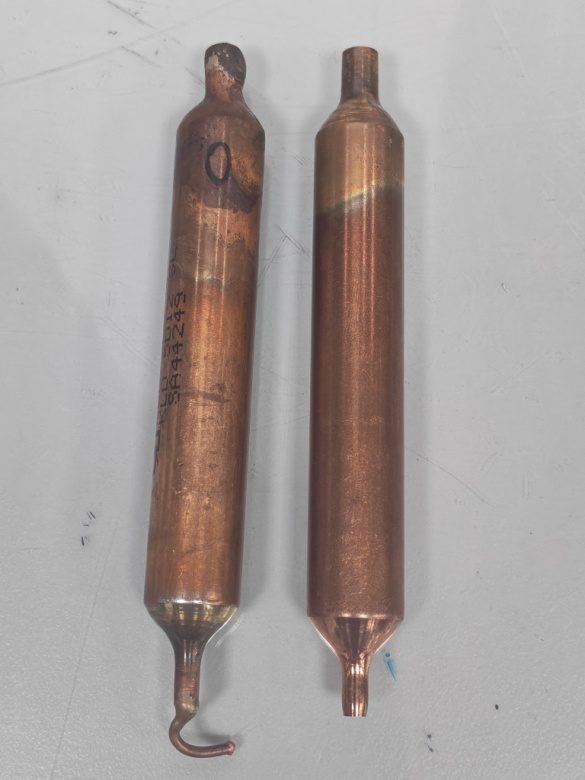
A customer called, angry: a heat-exchanger copper tube had cracked after only six months and all the refrigerant was gone. What looked like a filter-drier failure took three weeks of forensic work to solve. The real culprit was hiding in plain sight.
An Expensive, Frustrating Failure
A cracked copper tube with a full refrigerant leak is one of the most costly incidents in refrigeration: downtime, claims and a damaged reputation. Yet internally we had a doubt. A molecular-sieve filter drier is the "goalkeeper" of the system - it absorbs water and contaminants and cleans the refrigerant. It produces no stress and no heat, so how could it crack a copper tube? The customer's suspicion was reasonable, and so was ours. We had to find the truth with evidence, not argument.
Round One: The Tube Mill
The usual suspect is the tubing itself - deep outer scratches, inner scoring or internal oxidation that tears open when the tube is expanded. We sent the failed tube straight for eddy-current testing and metallographic examination. The mill's inspection records were complete, there were no original defects, and the microstructure was normal. The material was cleared.
Round Two: The Fabrication Process
If the material was sound, fabrication was next: over-bent tubes, over-sized flaring, cutting burrs, or unequal U-bend lengths can make a tube crack months later, slowly and quietly. We pulled the process parameters and fabrication records for that batch, checked tolerances one by one, and sampled bent and flared parts from the same lot. Everything sat within specification. Another dead end.
The Turning Point: One Overlooked Detail
Stuck in the impasse, a field engineer mentioned almost in passing: "Odd - this unit runs at a coastal site. Every other machine is fine; only this one cracked." Three facts clicked together: seaside, humid, and only machines in that specific environment failing. This was not ordinary mechanical cracking - it looked like corrosion cracking. A pure material or process problem would fail across a whole batch, not pick its environment.
The Truth: Chloride-Induced Stress Corrosion Cracking
We sent the crack region for SEM imaging and EDS elemental analysis and sectioned samples for metallography. Under the microscope the cracks showed the classic Y-shaped branching - the fingerprint of stress corrosion cracking (SCC), not fatigue. EDS detected clear chloride (Cl) enrichment at the cracks, with elevated oxygen and reduced copper.
The picture was complete: the tube had spent months under tensile stress, in the presence of chloride and moisture, and suffered SCC. Copper loses its passive protection in a chloride environment; chloride attacks the grain boundaries at stress-concentration points and propagates slowly and invisibly. Six months is exactly the time a crack needs to initiate and break through - by the time it shows on the surface, the interior is already compromised.
Where Did the Chloride Come From?
- Refrigerant or refrigeration-oil degradation releasing chlorine-bearing compounds under high temperature and pressure;
- Residual cleaning/degreasing agent left in the system at installation and never fully blown dry;
- Coastal, salty air penetrating over time through micro-leaks.
Bends and flares already carry residual stress - precisely the locations SCC prefers to attack.
Was Our Filter Drier Responsible?
The drier was not at fault, but it shows the value of a disciplined process. A molecular-sieve filter drier captures solid particles and water, yet it cannot stop chloride already dissolved in the refrigerant - that sits outside what any drier can do. What resolved the case was our complete inspection chain: appearance, sectioning, metallography, hardness, SEM/EDS composition analysis and traceability records. Instead of a blame loop, the evidence identified the real mechanism.
From "Whose Fault" to "Which Link"
The investigation took three weeks. Had we simply insisted "our drier is fine", or quietly paid the claim, the account would have stayed a muddle forever. The value of root-cause work is turning "whose problem" into "which link": a material defect means evidence-based talks with the supplier; a welding or process issue means fixing the next batch; a corrosive operating environment means helping the customer change refrigerant, improve cleaning and add surface protection - which is genuine value-added service, and the start of the next order. In refrigeration, the most expensive thing is never the material. It is guessing.